

 DEUTSCH
“I have a large beautiful room with a very comfortable sofa. It only costs 23 fr. This is not much, after all. In addition, 6 upholstered chairs and 3 wardrobes. One could hold a meeting in it.”
Albert Einstein in a letter to Mileva Maric, February 4, 1902
Albert Einstein’s residences in Bern
When the 23-year-old qualified specialist teacher Albert Einstein arrived in Bern in February 1902 after a 4 ½ month stay in Schaffhausen, the city had approximately 69,000 inhabitants. The reason for his move was the expected employment as third-class technical expert with “Eidgenössisches Amt für geistiges Eigentum” [Swiss Federal Institute of Intellectual Property]. His financial situation urged him to live an extremely modest life.
In the following, Einstein‘s seven residences in Bern are listed in chronological order. Except for a few events, additional information is mostly waived.
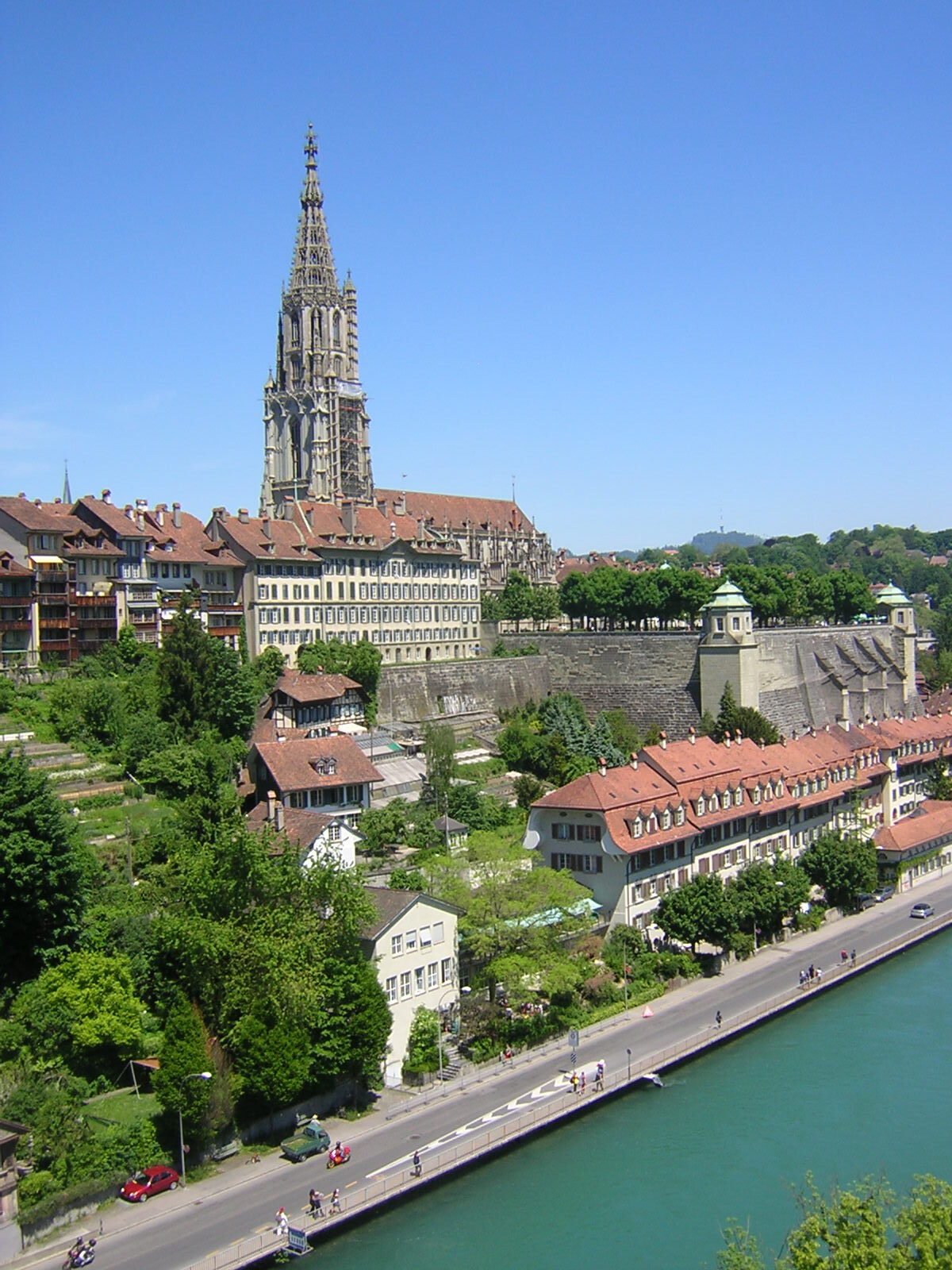
Overview of Einstein‘s residences in Bern
| Gerechtigkeitsgasse 32 | February 04, | 1902 | until | May 31, | 1902 |
| Thunstrasse 43a | June 01, | 1902 | until | August 14, | 1902 |
| Archivstrasse 8 | August 15, | 1902 | until | January 09, | 1903 |
| Tillierstrasse 18 | January 10, | 1903 | until | October 28, | 1903 |
| Kramgasse 49 | October 29, | 1903 | until | May 15, | 1905 |
| Besenscheuerweg 28 today Tscharnerstrasse 28 | May 16, | 1905 | until | April 27, | 1906 |
| Aegertenstrasse 53 | April 28, | 1906 | until | October 20, | 1909 |
Remark concerning the overview of Einstein‘s residences:
Partly it is today, after more than 100 years, no longer possible to list the exact data of the respective dates of moving in and out from the residences. Also the information in the relevant Einstein literature is incomplete, i.e. inconsistent at these points. Small deviations of the data mentioned in the table are thus possible. However, the residence registrations of the city of Bern which are mentioned in the following texts are correct!
Gerechtigkeitsgasse 32
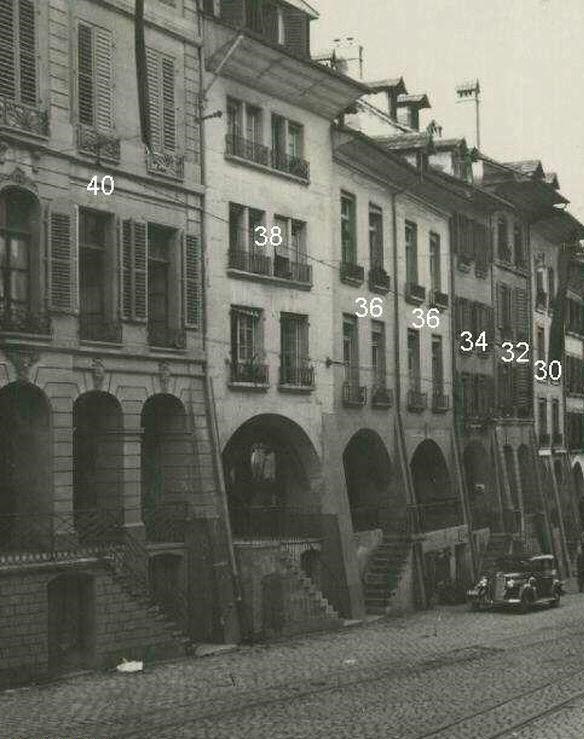
Albert Einstein was almost without means, but after a long search he found a modest room (bachelor pad) in the old town of Bern in Gerechtigkeitsgasse 32, on the first floor of the house of Anna Sievers. There he lived from February 04 until Mai 31, 1902. On February 11, 1902 Einstein registered with the police.
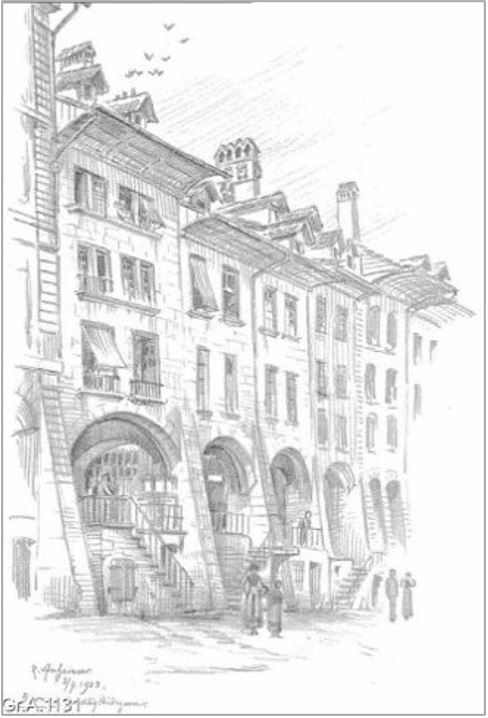
Gerechtigkeitsgasse 38 – 32 (1903)
In a letter to Mileva Maric dated February 04, 1902 he described his room, added by a hand-drawn sketch.
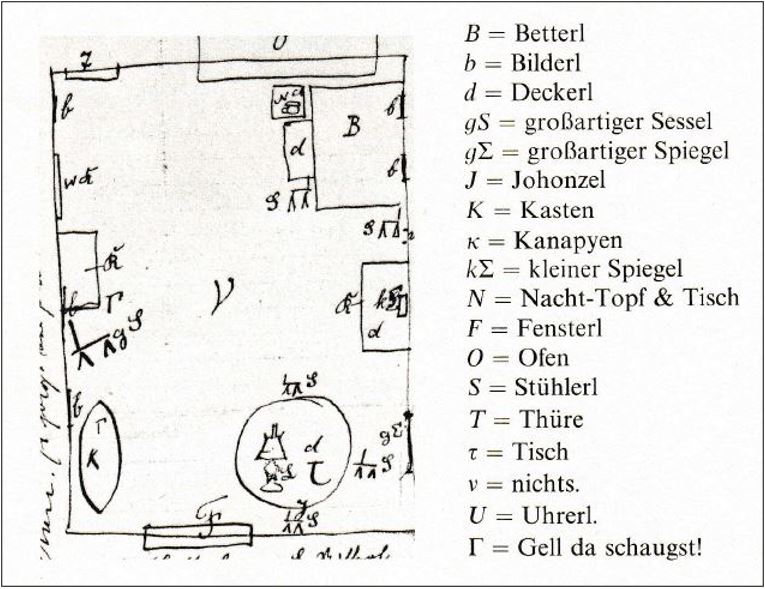
Translation of the words in the sketch from the top to the bottom:
Bed, pictures, blanket, great armchair, great mirror, nickname for Mileva Maric, dresser, sofa, small mirror, chamber pot & table, window, oven, chair, door, table, nothing, clock, Now you are impressed, aren’t you?
Max Talmud, a friend and mentor from the Munich time, who visited him, had the impression that the room is a “small, poorly furnished room”. Einstein had to earn a living. To bridge the time until his employment at the Patent Office in Bern, he advertised on February 05, 1902 in the Anzeiger für die Stadt Bern [newspaper for the city of Bern]:
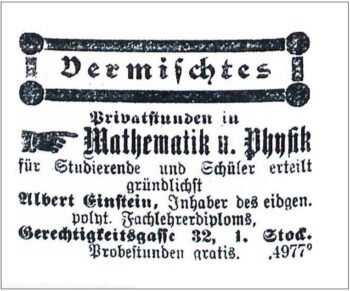
Translation of the advertisement:
Miscellaneous
Private lessons in
mathematics and physics
for students and pupils gives
thoroughly
Albert Einstein, owner of the
Swiss polyt. subject teacher diploma,
Gerechtigkeitsgasse 32, 1. floor.
Trial lessons for free.
On February 08 Einstein wrote in a letter to Mileva Maric: “The situation with the private lessons isn’t bad at all. I have already found two gentlemen, an engineer & an architect & more in prospect. I am going to give both of them together a kind of a private course & am getting 2 fr. per man and lesson. This is quite nice, isn’t it.”
It is not known how the story went on with the “two gentlemen”. But it is known that Einstein got to know Maurice Solovine, a Romanian philosophy student, through the advertisement. With him and Conrad Habicht, a friend from Schaffhausen, he founded the “Olympia Academy” in 1903, which will accompany us until Kramgasse 49 and far beyond that.
In January 1902 Lieserl, the illegitimate daughter of Mileva Maric and Albert Einstein, was born in Novi Sad.
Scientifically, Einstein worked on his physical theories research with great motivation. Thus, he sent an article to the Annalen der Physik, a journal published by Max Planck.
Thunstrasse 43a
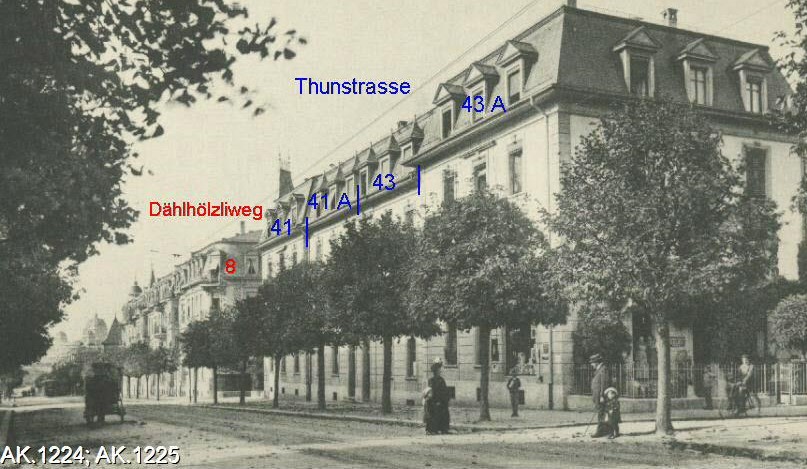
On June 7, 1902, Einstein registered his second apartment in Thunstrasse 43a with retroactive effect to the beginning of the month. The apartment was located on the other side of the Aare in the very remote suburb Kirchenfeld. The landlord was the Dosch family.
On June 19, 1902, Einstein finally received the long-awaited acceptance of the Patent Office in Bern. In the letter it says: “[…] At its session of 16 June 1902, the Federal Council elected you provisionally as a Technical Expert Class 3 of the Fed. Office for Intellectual Property with an annual salary of 3.500 fr.”
Thus, also Einstein‘s financial worries were over. His first day of work at the Patent Office was Monday, June 23, 1902, room 86 on the third floor.
Archivstrasse 8
In August 1902 Einstein once again changed his place of residence, however, stayed in the suburb of Kirchenfeld. On August 14, 1902 he registered with the authorities. His landlady was the widow Bertha Hausmann-Louis. In her house he lived in the attic and had a nice view of the Bernese local mountain (the Gurten), the Bernese Alps, and the Aare. He stayed there for the next 5 months. He felt very comfortable in the house. To his friend Hans Wohlwend he wrote: “My landlady has a marvelous violin and Bern has a beautiful countryside, and I am in a cheerful, light-headed mood, because my worries are now mostly gone, except that my father is very ill, unfortunately.”
Einstein‘s father Hermann died on October 10, 1902 in Milan. On January 06, 1903 Albert Einstein married Mileva Maric – against the will of the families.
The daughter of the landlady reported: “He could only make my mother [Bertha Hausmann-Louis] angry with again and again forgetting the keys. At the most inappropriate hours of the night he rang her from sleep and shouted: “Here is Einstein – I once again forgot my keys.” This was also the case when Einstein and his wife came home from their marriage with their two witnesses late in the evening and he unsuccessfully looked for the keys in his pockets. Then he once again had no other choice than shouting out loud: “Here is Einstein – I […]”.
Tillierstrasse 18
Already a few days after the marriage they moved again. The new address was Tillierstrasse 18 in the suburb of Kirchenfeld. On January 10, 1903 Einstein and his wife Mileva registered with the authorities. The landlord was the manufacturer Peter Kramer of the company Wüthrich & Co. (a Bernese machine factory and mechanical workshop). Despite the young marital bliss and his daily work at the Patent Office, he found the time for further scientific work. To his friend Michele Besso Einstein wrote in January 1903: “Well, now I am a married man and am living a very pleasant, cozy life with my wife. She takes excellent care of everything, cooks well, and is always cheerful. […] Last week Miza had the flu, and now I have it. Today I could not possibly go to the office; now I feel better, so that I’ll probably be at my post again tomorrow. […] In the near future I’ll concern myself with the molecular forces in gases, and then I’ll do comprehensive, extensive studies in electron theory.”
At Easter of the year 1903 Einstein and Maurice Solovine founded the “Olympia Academy”. Conrad Habicht joined shortly after them.
In the autumn of 1903, Lieserl might have been given up for adoption in Hungary.
The stay of the spouses in Tillierstrasse lasted for approximately 10 months.
Kramgasse 49
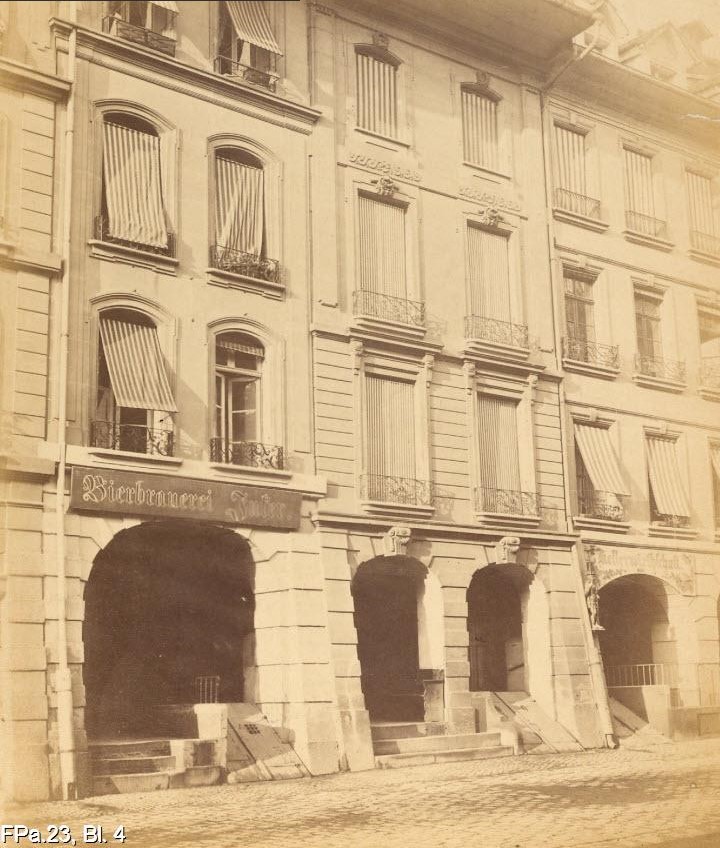
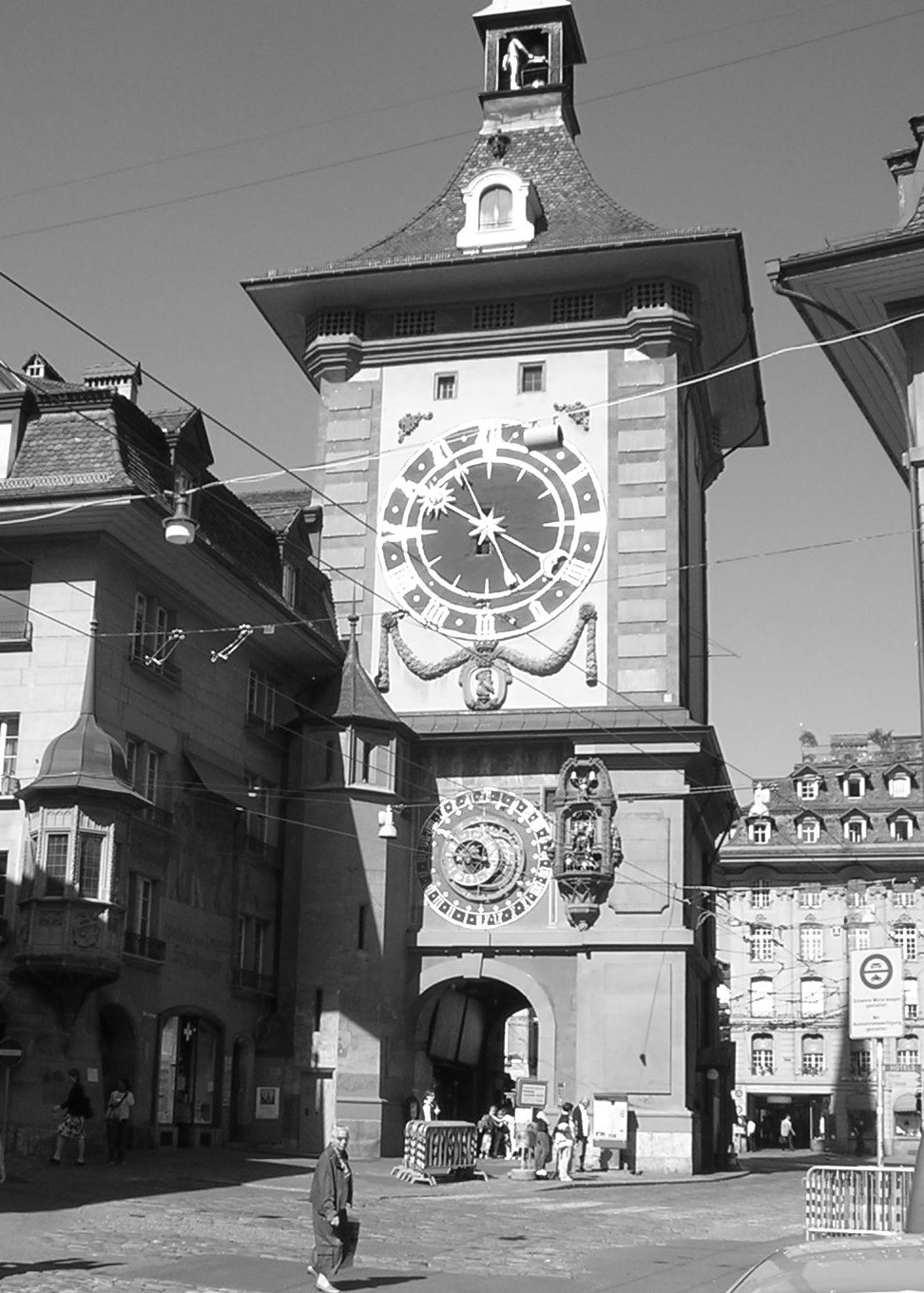
As of October 1903 we find Einstein and his wife in Kramgasse 49 in the old town of Bern. It belonged to the former landlord G. Mathys-Juker. On the ground floor there was his brewery / restaurant “Zum Unteren Juker”, at Einstein‘s arrival renamed into “Brasserie zum Gurten”. Einsteins lived on the 2nd floor with a view of the “most beautiful” Bernese street. The apartment (ca. 55 m²) was located in direct vicinity to the Zytglogge (Zeitglocke) and the Zähringerbrunnen. Officially, he registered on October 29, 1903. Through the location of the new apartment, Einstein‘s way to the office was shorter. The move to Kramgasse 49 should revolutionize the physical world!
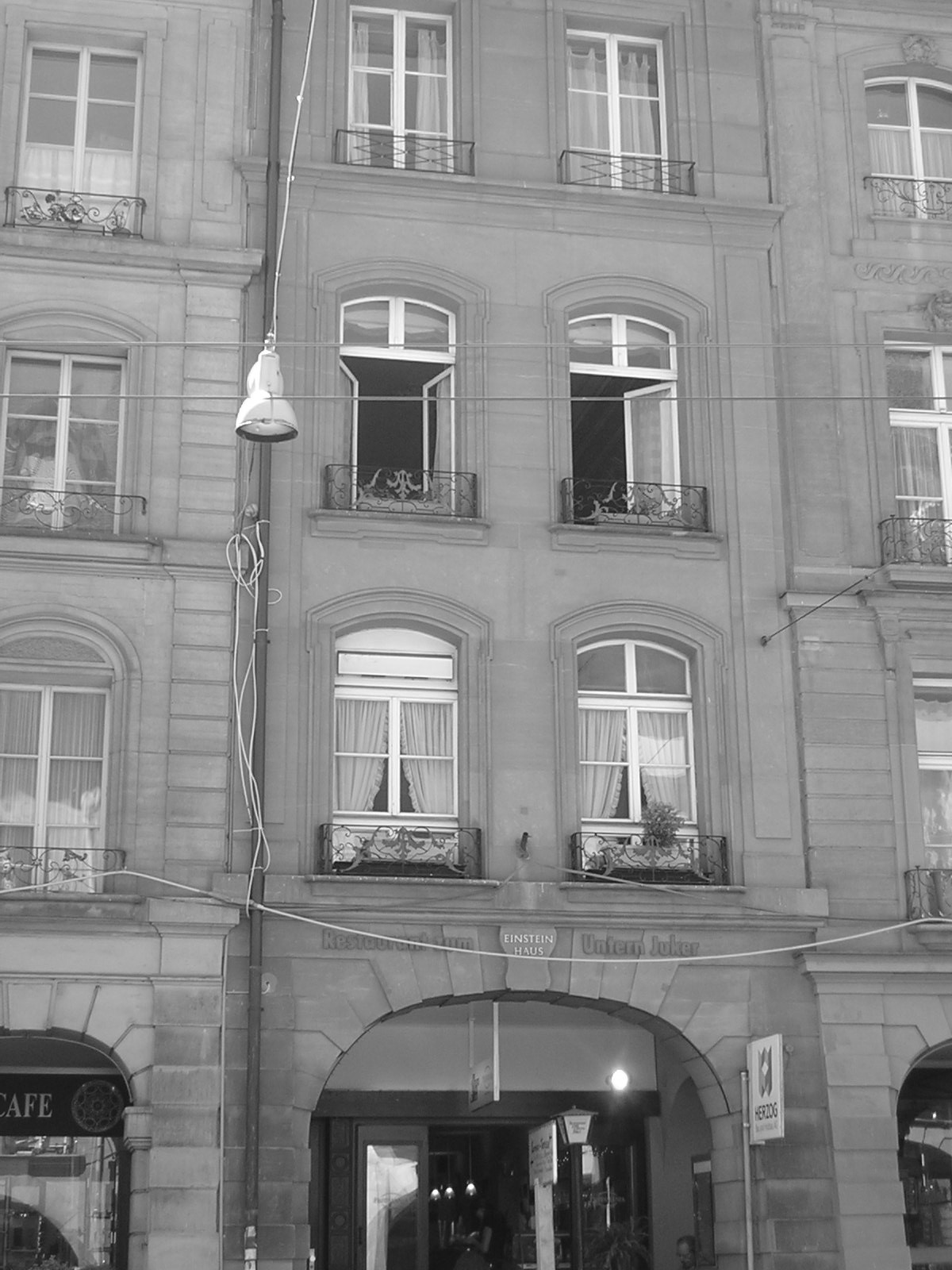
Bern (2005)
Hans Albert, Einstein‘s and Mileva‘s first son, was born in Kramgasse 49 on May 14, 1904. To the parents of Mileva, Einstein wrote on May 15, 1904: “A healthy boy was born to us yesterday. Miza is fine and sends you her love. […] The boy is also named Albert.”
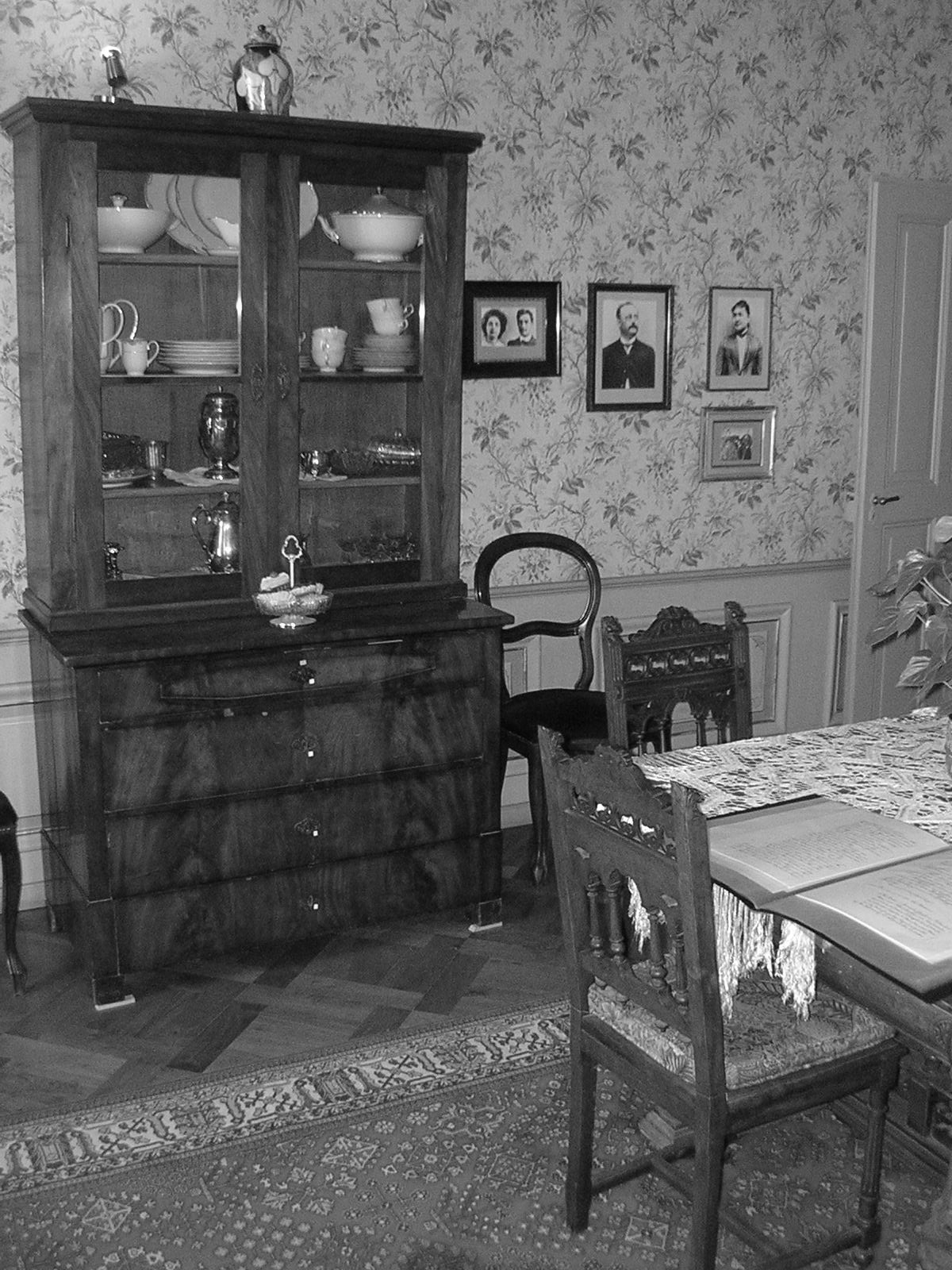
(2005, Einstein House, Bern)
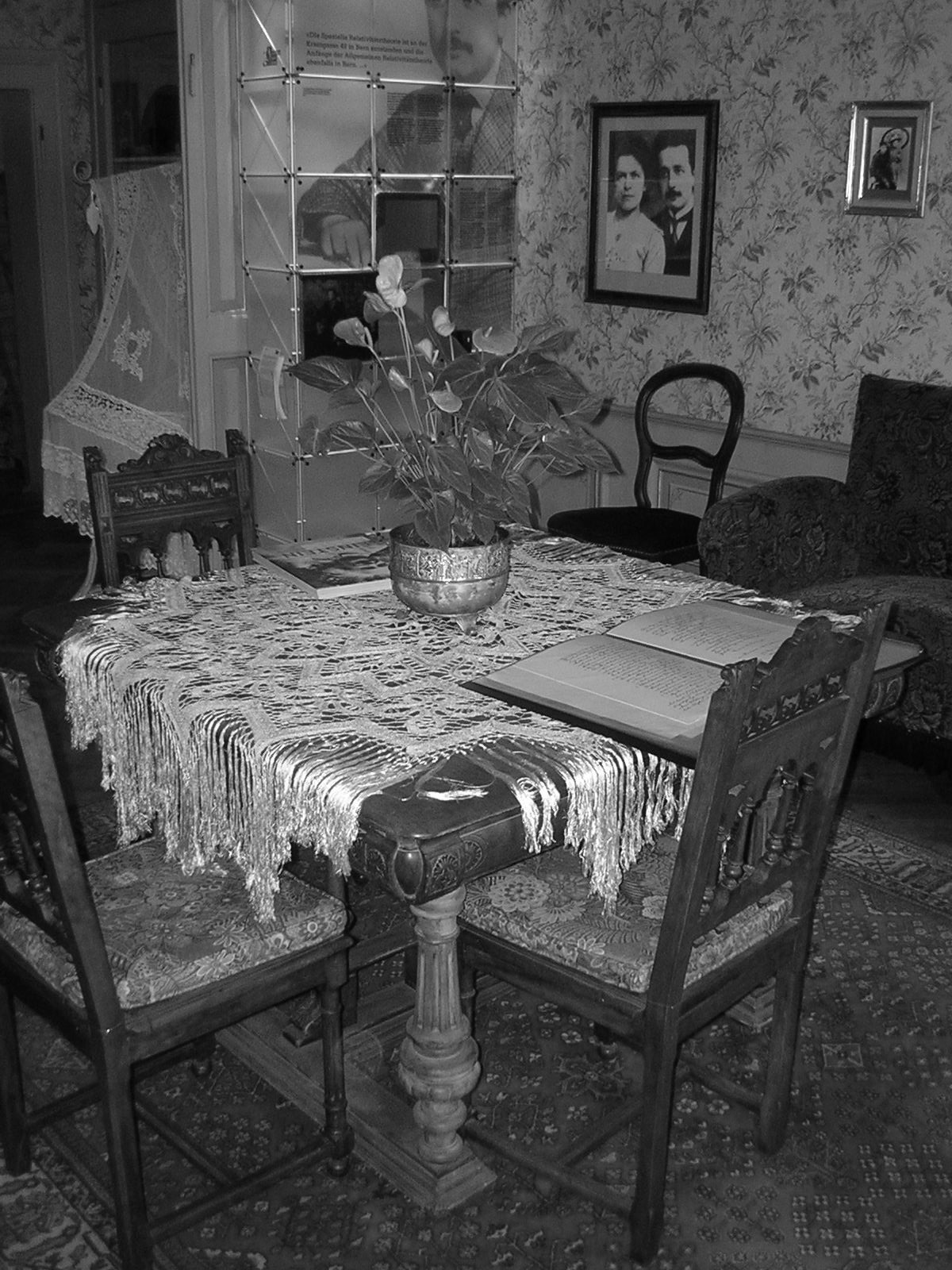
(2005, Einstein House, Bern)
On September 20, 1904 Einstein was permanently employment at the Patent Office.
1905 was Einstein‘s “annus mirabilis”. He published several groundbreaking works in the Annalen der Physik which revolutionized the basics of physics around 1900. One of the works, On the Electrodynamics of Moving Bodies, contained the special theory of relativity. In one of the other works, he deduced the famous formula E = mc2. In April Einstein handed in his work, A New Determination of Molecular Dimensions, as dissertation at the University of Zurich, which was accepted there at the end of July.
As Josef Sauter, a friend and colleague at the Patent Office, reported Einstein was not above to get the coals for heating and cooking himself at the merchant with a handcart, and to carry the bags on his shoulders in the apartment on the second floor. This was probably also for cost reasons.
A memorial plaque at the Laubenpfeiler (a pillar which supports a covered, open pergola) of Kramgasse 49 was supposed to be built from the middle to the end of the 50ies.
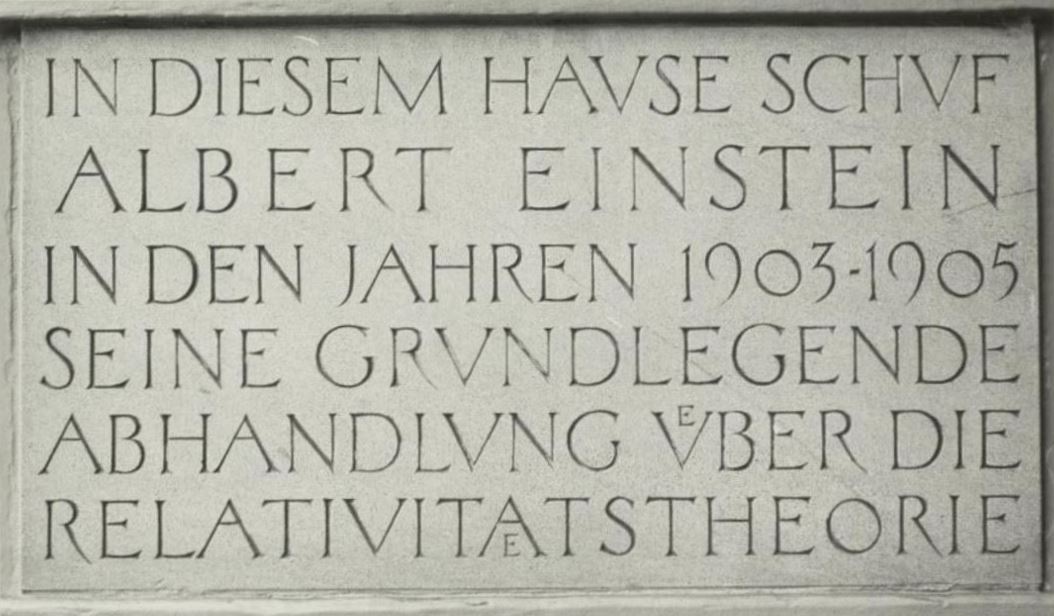
“IN THIS HOUSE, ALBERT EINSTEIN
CREATED HIS BASIC ESSAY
ON THE THEORY OF RELATIVITY IN THE YEARS
1903-1905”
In the apartment also regular meetings of the “Olympia Academy” took place.
Einstein House in Bern
The apartment on the second floor of Kramgasse 49, in which Einstein had lived from 1903 to 1905, was renovated thanks to the Albert-Einstein-Gesellschaft in Bern (Albert Einstein Society) in the style of this time to reflect Einstein‘s decisive years in Bern. How had Einstein lived and in which surroundings did he create his most important works? The apartment can be visited by the public. (2026)
Besenscheuerweg 28
It is not clear why Einstein and his family changed their place of residence once again in May 1905. On May 13, 1905 he registered with the authorities. The new apartment in Besenscheuerweg 28 (today Tscharnerstrasse 28) was located somewhat outside of the city in the suburb Mattenhof. The landlord was the merchant Camille Senné.
On January 15, 1906 Einstein was graduated by the University of Zurich.
On April 1, 1906 he was promoted in the Patent Office to be a second-class technical expert.
During his whole time in Bern, also in Besenscheuerweg, Einstein restlessly worked – in addition to his work at the Patent Office – at scientific projects around theoretical physics.
On April 23, 1906 Einstein wrote to the gas and water company in Bern: “Please send someone to pick up a gas lamp not later than Thursday evening. I am moving on Friday.”
On the following Friday, April 27, the Einstein family moved out and to its last residence in Bern.
Aegertenstrasse 53
Thanks to the promotion in the Patent Office, Einstein was able to afford a larger apartment. His new apartment in Bern was in Aegertenstrasse 53 in the residential district Kirchenfeld. The landlord was the master roofer Gottfried Nacht. On June 1, 1906 he registered with the authorities. On April 27,1906 Einstein wrote to his friend Maurice Solovine: “I have moved again, this time back to Kirchenfeld (Aegertenstr. 53). As for my social life, I have not been meeting with anyone since you left. Even the conversations on the way home with Besso have now come to an end; I haven’t heard anything whatever from Habicht.”
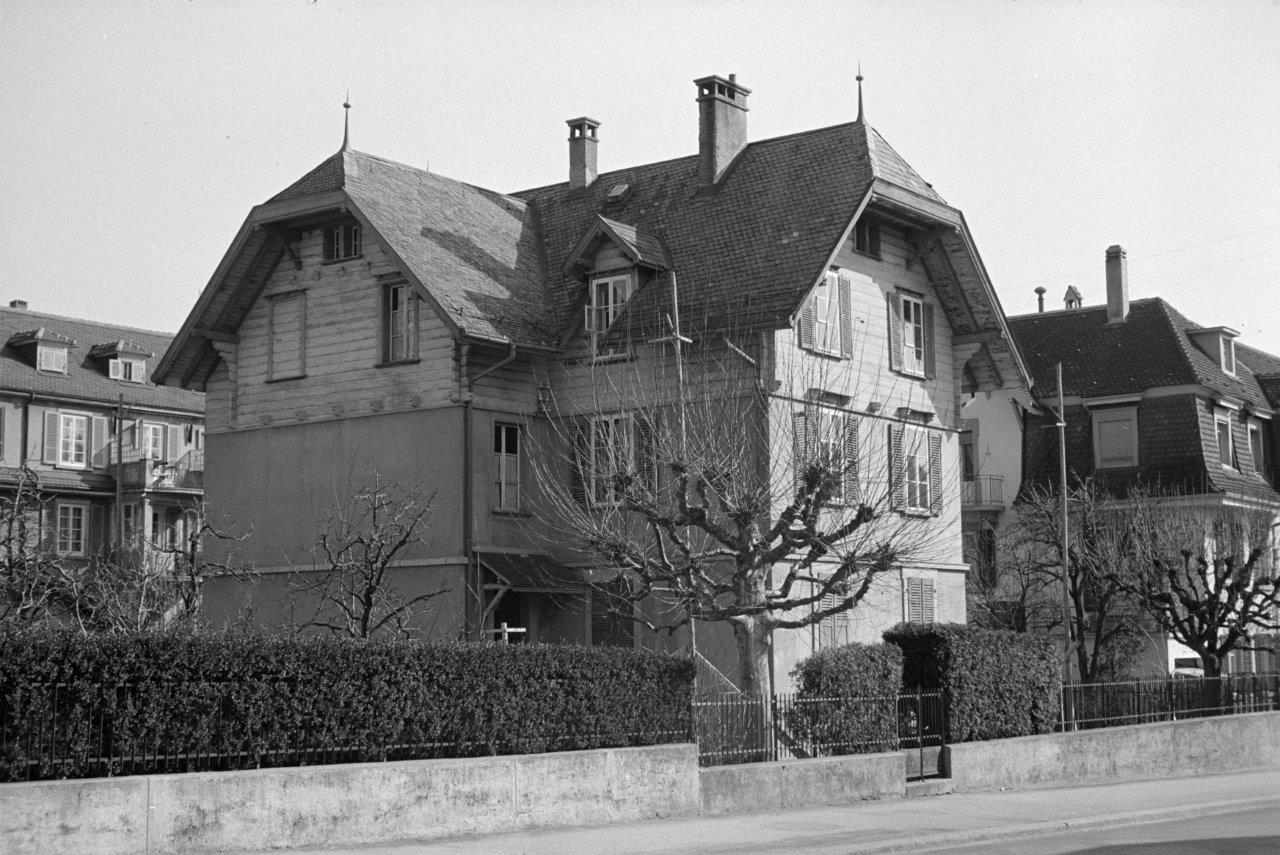
In 1907 Einstein began with the first considerations concerning the general theory of relativity and discovered the equivalence principle of mass and energy for uniformly accelerated systems. His application for habilitation was rejected by the University of Bern as his postdoctoral thesis did not suffice. Through the presentation of a new work Einstein habilitated in 1908 at the University of Bern and became a private teacher. At the end of the year he held his first lecture.
On May 7, 1909 Einstein received a call from the University of Zurich as extraordinary professor for theoretical physics.
In July 1909 Einstein received his first honorary doctorate by the University of Geneva. And there should be many more.
“Soon after that the farewell from Bern drew near, which Einstein had few problems with, though he had spent seven happy and – from a scientific point of view – probably the decisive years in the federal city. Later he sometimes was homesick for the placid Kramgasse and wrote: ‘It still was a nice time back then in Bern.’”
Source: Adolf W. Meichle, “Albert Einsteins Berner Jahre 1902-1909”
Officially, Albert Einstein deregistered in Bern on October 22, 1909. On October 15, 1909 he left the Patent Office and some days later also Bern.
On October 18 he moved to Zurich with his family to start teaching as extraordinary professor for theoretical physics at the university with the beginning of the winter semester.
07/26
Illustrations Credits:
Archive of the Author: 1, 8, 9, 10, 12
Burgenbibliothek Bern, Signature Gr.A.1131: 2
Burgenbibliothek Bern, Signature FPa.4, S.5, Nr.2: 3
The Collected Papers of Albert Einstein, Volume 1: 4
Public Domain: 5
Burgenbibliothek Bern, Signature AK.1224; AK1225: 6
Burgenbibliothek Bern, Signature FPa.23 Bl. 4: 7
Burgenbibliothek Bern, Signature FPa.30 Bl. 61: 11
Burgenbibliothek Bern, Signature N Walter Neeser 729 (29): 13
Bibliography:
| Editor: John Stachel, et al. | The Collected Papers of Albert Einstein Volume 1 | Princeton 1987 |
| Anna Beck, Translator Peter Havas, Consultant | The Collected Papers of Albert Einstein Volume 1, English translation of selected texts | Princeton 1987 |
| Editor: Martin J. Klein, et al. | The Collected Papers of Albert Einstein Volume 5 | Princeton 1993 |
| Anna Beck, Translator Don Howard, Consultant | The Collected Papers of Albert Einstein Volume 5, English translation of selected texts | Princeton 1995 |
| Ann M. Hentschel, Gerd Graßhoff | Albert Einstein “Those Happy Bernese Years” | Bern 2005 |
| Max Flückiger | Albert Einstein in Bern | Bern 1974 |
| Armin Hermann | Einstein – Der Weltweise und sein Jahrhundert – Eine Biographie | Munich 1994 |
| Adolf W. Meichle | Albert Einsteins Berner Jahre 1902-1909 | Bern 1992 |
| Albrecht Fölsing | Albert Einstein – Eine Biographie | Frankf/Main 1993 |